Funding Agency Announcements

Funding Agency Announcements
Research administration is a constantly-evolving landscape. This page relays recent funding agency announcements that directly impact proposal development and may prevent the submission of an application. Please review carefully.
You can find additional agency announcements and federal funding updates curated by the Office of Research Development.
Updated NIH SciENcv Certification language (9/2026)
- Open your existing SciENcv document
- Verify/update contents
- RE-CERTIFY
- Download the newly certified PDF
- Use that new PDF in your upcoming submission
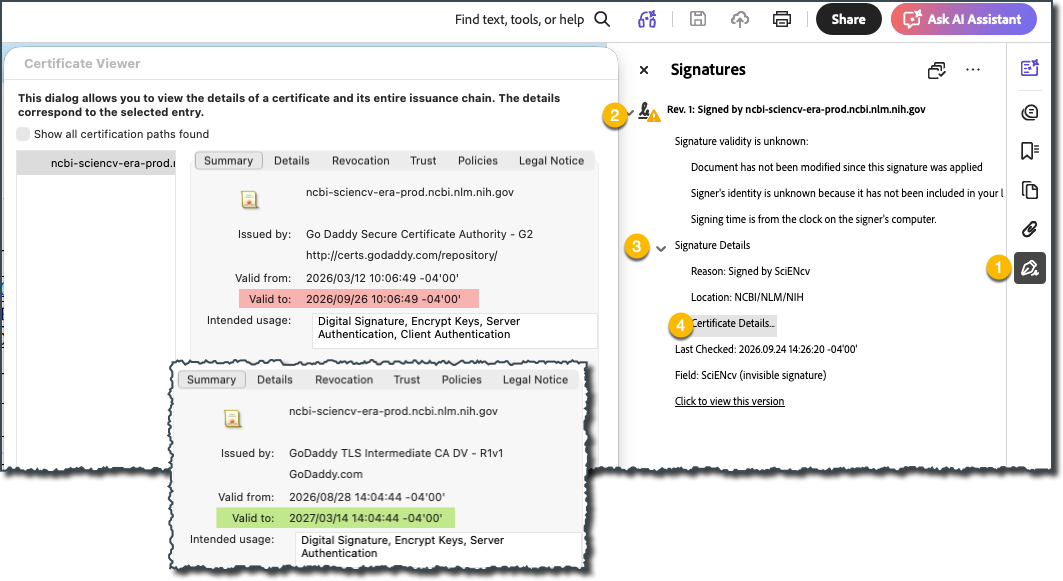
Prior Certifications expire 9/26/2026
NIH Replaces Letters of Support with Letters of Collaboration (7/2026)
With the implementation of Forms J in Fiscal Year 2027, the NIH will no longer allow letters of support but will instead require letters of collaboration to document any collaborative relationships with individuals that are not identified in the application as senior/key personnel or other significant contributors. Because senior/key personnel and other significant contributors must provide biosketches in the application, letters of collaboration from them are unnecessary and burdensome. Letters of collaboration will also be used to document other relevant contributions to the project's success, such as Material Transfer Agreements.
See full notice and additional resources here: https://grants.nih.gov/grants/guide/notice-files/NOT-OD-26-094.html
Prohibition on Collaborations with Restricted Entities (7/2026)
The U.S. National Science Foundation (NSF) is notifying the research community of a forthcoming policy prohibiting NSF funds from being expended on collaboration with entities on U.S. restricted parties lists, provided in Appendix A.
The U.S. government has determined that the behavior of these entities warrants restrictions based on national security and other foreign policy interests. Therefore, NSF has determined research security risk mitigation for NSF-funded projects involving these restricted entities is not sufficient. Accordingly, NSF plans to implement a new research security policy prohibiting collaboration on NSF-funded projects with these restricted entities, which can be found in Appendix A. As such, senior/key personnel will be prohibited from collaborating with these restricted entities on NSF-funded projects. Additionally, senior/key personnel will be prohibited from holding an appointment or position with, or receiving research support from, these restricted entities for the duration of the NSF award. NSF plans to revise its current guidance to include the following:
- NSF appropriated funds shall not be used for grants, contracts, other transactions or other assistance to an organization if the purpose is to conduct research in collaboration with restricted entities. This funding prohibition also extends to the employees of such restricted entities.
- Senior/key personnel are prohibited from holding an appointment or position with, or receiving research support from, a restricted entity. Further, senior/key personnel are prohibited from collaborating with a restricted entity, or employee thereof, on research funded by their NSF award.
To comply with this prohibition once it is effective, organization Authorized Organizational Representatives (AORs) and senior/key personnel will be required to certify to this effect at the time of proposal submission. Further, organizations will be responsible for ensuring that senior/key personnel are aware of and comply with this prohibition and for identifying and addressing prohibited activities before NSF funds are expended.
Please see full notice here: https://www.nsf.gov/funding/information/dcl-prohibition-collaborations-entities-us-prohibited-party
NIH Implements Common forms for Biosketch and CPS (12/2025)
In an effort to support strong collaboration between Federal research agencies, NIH is adopting the Common Forms for Biographical Sketch and Current and Pending (Other) Support as per the White House Office of Science and Technology Policy (OSTP) memorandum on Policy Regarding Use of Common Disclosure Forms. This Guide Notice provides details for the Common Forms, NIH Biographical Sketch Supplement, and instructions required for use for application due dates and Research Performance Progress Report (RPPR) submissions on or after January 25, 2026.
See full release for additional information and resources: https://grants.nih.gov/grants/guide/notice-files/NOT-OD-26-018.html
Research Security Training Requirements for NIH (12/2025)
In accordance with Section 10634 of Act, each covered individual (for NIH this is defined as senior/key personnel) listed on an NIH grant application must certify that they have completed RST within 12 months of the date of application submission. NIH does not collect Current and Pending (Other) Support at the time of application based on our Just-in-Time policy. Therefore, NIH will collect the individual certification at the time of the application submission, through the Biographical Sketch in SciENcv.
See full notice here: https://grants.nih.gov/grants/guide/notice-files/NOT-OD-26-017.html
NSF Annual MFTRP Certification Requirement (6/2025)
NSF Annual MFTRP Certification Requirement for PIs and Co-PIs
Starting June 7, 2025, the National Science Foundation (NSF) is implementing a new annual certification process for Principal Investigators (PIs) and co-Principal Investigators (co-PIs). This requirement applies to individuals listed on NSF awards issued on or after May 20, 2024, and is part of the NSF’s ongoing efforts to address concerns related to Malign Foreign Talent Recruitment Programs (MFTRPs).
Under this policy, PIs and co-PIs must log into Research.gov and confirm each year that they are not involved in any MFTRP. This certification is mandatory for maintaining eligibility to serve in these roles on NSF-funded projects. Those currently participating in such programs are ineligible to be named as senior or key personnel on NSF proposals or awards issued after the effective date.
Key points to note:
- Only individuals (not institutions) are required to complete this certification.
- If a PI or co-PI has multiple active NSF awards, they only need to certify once per year.
- Certification status can be viewed in the Academic/Professional Information section of the Research.gov profile.
- NSF plans to expand this requirement to include all senior/key personnel in the future.
- Organizations will eventually gain access to view these certifications.
For more details, visit the NSF website: https://www.nsf.gov/research-security#mftrp. If you have questions, you should email NSF directly at researchsecurity@nsf.gov.
Changes to NSF Biosketch and Current/Pending Templates (5/2024)
As of May 2024, the National Science Foundation (NSF) requires the use of NSF-approved formats for Biographical Sketch and Current and Pending (Other) Support documents submitted with proposals. Investigators must prepare these documents using either SciENcv (Science Experts Network Curriculum Vitae) or the NSF fillable PDF forms, in accordance with the Proposal & Award Policies & Procedures Guide (PAPPG) (NSF 20-1).
Biographical Sketch and Current and Pending Support Websites
- The NSF Biographical Sketch and Current and Pending Support websites include links to NSF forms instructions.
- NSF recommends users utilize SciENvc to generate your biosketch. Please keep in mind that Synergistic Activities is now a separate on-page document. Key personnel are required to disclose contracts associated with participation in foreign governments, instrumentalities or entities, including foreign government-sponsored talent recruitment programs. Individuals are prohibited from participating in malign foreign talent recruitment programs.
- The following certification must be completed on each Biosketch: "I certify that the information provided is current, accurate, and complete. This includes but is not limited to information related to domestic and foreign appointments and positions. I also certify that, at the time of submission, I am not a party in a malign foreign talent recruitment program. Misrepresentations and/or omissions may be subject to prosecution and liability pursuant to, but not limited to, 18 U.S.C. §§ 287, 1001, 1031 and 31 U.S.C. §§ 3729-3733 and 3802."
- PIs and co-PIs must include an NSF-approved format for Current and Pending Support when notifying NSF that active other support has changed since the award was made, or since the most recent annual report.
NSF Safe and Harassment-free Fieldwork Plan (1/2023)
Effective January 30, 2023, the National Science Foundation (NSF) requires proposers to have in place a plan for Safe and Harassment-free Fieldwork (SAHF) for projects that include off-campus or off-site research. Please visit the Rowan SAHF website to learn more and view a 2-page template available for our PIs.